 Rivallens AI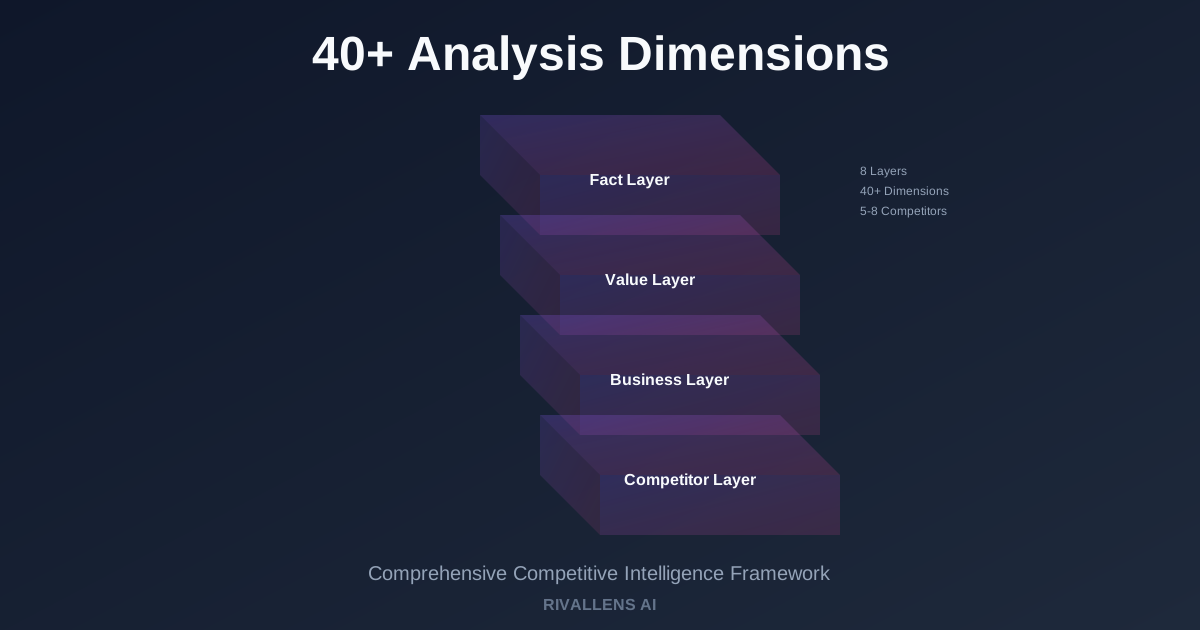
40+ Dimensions of Competitive Intelligence: What Rivallens AI Analyzes and Why Every Dimension Matters
Most competitive analysis is shallow. A quick look at a competitor's website, a glance at their pricing page, maybe a read through some customer reviews. That's not analysis — that's browsing.
Rivallens AI approaches competitive intelligence differently. Every report covers 40+ dimensions across 10 specialized layers, ensuring you get the complete picture — not just the surface-level data that's easy to find.
Here's a comprehensive breakdown of what each layer covers and, more importantly, how to use each dimension to make better decisions.
Layer 1: Fact Layer — The Foundation
Purpose: Extract verified, factual data directly from the target product's website.
The Fact Layer is your ground truth. Every other layer builds on this foundation.
Dimensions Covered:
| Dimension | What It Tells You | How to Use It |
|---|---|---|
| Product Positioning | How the product describes itself and its market | Identify messaging angles to differentiate against |
| Target Users | Who the product is built for (primary and secondary personas) | Find underserved user segments |
| Core Features | Structured list of all product capabilities | Build your feature comparison matrix |
| Pricing Structure | All publicly available plans and price points | Benchmark your own pricing |
| Traffic Data | Monthly visits, traffic sources, geo distribution | Gauge market demand and audience location |
| Technology Stack | Frameworks, languages, and infrastructure detected | Understand technical complexity and maturity |
| Competitor Mentions | Products the company compares itself against | Discover indirect competitors you hadn't considered |
| Revenue Estimates | Estimated annual revenue based on multiple signals | Assess market size and competitor strength |
| Company Information | Team size, location, year founded, funding | Understand competitor resources and stage |
| Marketing Channels | How the product acquires users | Identify effective channels for your own growth |
Key Decision: Is This Market Worth Entering?
The Fact Layer gives you the raw data to answer: "How big is this opportunity, and how crowded is the space?"
- High traffic + few competitors = Green light
- High traffic + many competitors = Need strong differentiation
- Low traffic = Niche market, verify demand before building
Layer 2: Value Layer — Why People Pay
Purpose: Understand the psychological and practical reasons users choose to pay for this product.
This is where most competitive analysis stops — but it's where Rivallens AI's analysis gets interesting.
Dimensions Covered:
| Dimension | What It Tells You | How to Use It |
|---|---|---|
| Payment Motivation | The core pain point that drives willingness to pay | Build features that solve this pain better |
| Usage Scenarios | Context in which users reach for the product | Design your UX around these moments |
| Value vs. Alternatives | Why users choose this over free/cheaper options | Articulate your own value proposition clearly |
| User Psychology | Emotional and rational purchase triggers | Craft marketing that hits these triggers |
| Switching Costs | What keeps users from leaving | Build features that create stickiness |
Key Decision: What Should Your Value Proposition Be?
If competitors solve "team collaboration" but users really pay for "reducing meeting time," that's your angle. Build and market against the real pain point, not the surface-level feature.
Layer 3: Business Layer — How Money Flows
Purpose: Analyze the complete business model and financial dynamics.
The Business Layer goes beyond "they charge $29/month" to understand the entire economic engine.
Dimensions Covered:
| Dimension | What It Tells You | How to Use It |
|---|---|---|
| Revenue Model | Subscription, usage-based, marketplace, or hybrid | Choose the model that fits your product best |
| Estimated Revenue | Data-backed revenue estimation | Understand competitor resources and market share |
| Market Size (TAM) | Total addressable market estimate | Validate your market size assumptions |
| Competitive Moats | What protects this business | Identify moats you can build or circumvent |
| Unit Economics | Estimated CAC, LTV, payback period | Benchmark your own unit economics |
| Growth Model | PLG, sales-led, community-driven, or hybrid | Design your growth strategy |
| Scalability | How easily the business can scale | Understand growth constraints |
| Risk Factors | Regulatory, competitive, and tech risks | Avoid the same pitfalls |
| Exit Potential | Acquisition targets or IPO readiness | Understand long-term competitive dynamics |
Key Decision: How Should You Monetize?
If competitors in your space all use seat-based pricing but customers complain about it, consider usage-based or value-based pricing. The Business Layer reveals not just what competitors do, but what's not working.
Layer 4: Competitor Layer — The Full Landscape
Purpose: Map the complete competitive landscape and identify your strategic position.
Dimensions Covered:
| Dimension | What It Tells You | How to Use It |
|---|---|---|
| Competitor Identification | 5-8 direct and indirect competitors | Know who you're really competing against |
| Feature Comparison | Side-by-side capability matrix | Find feature gaps to exploit |
| Pricing Comparison | Visual pricing tier breakdown | Position your pricing strategically |
| Audience Overlap | Who competes for the same users | Understand competitive intensity |
| Differentiation Gaps | Where competitors fall short | Your roadmap priorities |
| Market Entry Opportunities | Underserved segments ripe for entry | Your go-to-market strategy |
Key Decision: Where Should You Play?
The Competitor Layer often reveals that the "obvious" market is overcrowded, but adjacent segments are wide open. This is how startups beat incumbents — not by being better at the same thing, but by playing a different game entirely.
Layer 5: Growth Signals — Momentum and Trajectory
Purpose: Track real-time signals that indicate where a competitor is heading.
Dimensions Covered:
| Dimension | What It Tells You | How to Use It |
|---|---|---|
| Traffic Trends | Is the product growing, stable, or declining? | Gauge competitive threat level |
| Social Media Momentum | Follower growth, engagement rates | Understand brand strength and audience |
| Hiring Patterns | What roles are being hired? | Predict future product direction |
| Product Updates | Recent feature launches and changes | Stay current on competitive moves |
| Funding Activity | Recent rounds, total raised, key investors | Assess financial firepower |
| Partnership Signals | New integrations and alliances | Identify ecosystem plays |
Key Decision: Are They a Threat or an Opportunity?
A competitor with declining traffic despite heavy funding is a different threat than one with hockey-stick growth and no outside capital. The Growth Layer helps you distinguish between paper tigers and real threats.
Layer 6: Insights — Strategic Synthesis
Purpose: Synthesize all data layers into actionable strategic insights.
This is where Rivallens AI's AI truly shines — connecting dots that a human analyst might miss.
Dimensions Covered:
| Dimension | What It Tells You | How to Use It |
|---|---|---|
| Market Positioning | Where this product fits in the landscape | Find your unique position |
| Differentiation Opportunities | Specific gaps you can exploit | Prioritize your roadmap |
| Threat Assessment | How much should you worry? | Allocate resources appropriately |
| Strategic Recommendations | Concrete, data-backed suggestions | Guide your strategy |
| Market Predictions | Where the market is heading | Plan for the future |
Key Decision: What's Your Strategy?
The Insight Layer turns raw data into strategy. Instead of "Competitor X has feature Y," you get "Competitor X is weak in enterprise compliance — here's how to exploit that in your enterprise sales pitch."
Layer 7: Action Items — Your Execution Plan
Purpose: Convert insights into a prioritized, time-bound action plan.
Dimensions Covered:
| Dimension | What It Tells You | How to Use It |
|---|---|---|
| Quick Wins (0-30 days) | Immediate actions with low effort, high impact | Start executing today |
| Short-term Plays (1-3 months) | Strategic adjustments to your roadmap | Adjust your sprint planning |
| Long-term Moves (3-6 months) | Major initiatives to consider | Plan your quarterly goals |
| Cost Estimates | Resource requirements for each action | Budget and resource planning |
| Success Metrics | How to measure impact | Track your progress |
Key Decision: What Do You Do on Monday Morning?
The Action Layer bridges the gap between "interesting analysis" and "business impact." Every recommendation comes with a timeline, resource estimate, and success metric.
Layer 8: Updates — What Changed Recently
Purpose: Track the latest changes, news, and developments.
Dimensions Covered:
| Dimension | What It Tells You | How to Use It |
|---|---|---|
| Product Changes | New features, UI redesigns, pricing updates | Respond to competitive moves quickly |
| Company News | Funding, leadership, acquisitions | Understand strategic shifts |
| Market Moves | New market entries, partnerships | Anticipate competitive dynamics |
| Sentiment Shifts | Changes in reviews and ratings | Spot quality or satisfaction issues |
Key Decision: Is Your Intelligence Current?
Competitive intelligence has an expiration date. The Update Layer ensures you're always working with fresh data.
Putting All 40+ Dimensions to Work
The power of Rivallens AI's framework isn't just in the individual dimensions — it's in how they work together:
- Fact Layer tells you what is happening
- Value Layer tells you why customers care
- Business Layer tells you how money is made
- Competitor Layer tells you who you're up against
- Growth Layer tells you where things are heading
- Insight Layer tells you so what it means
- Action Layer tells you what to do about it
- Update Layer tells you what's new since last time
Together, they transform competitive analysis from a static snapshot into a dynamic, actionable intelligence system.
Experience All 40+ Dimensions Yourself
Reading about the framework is one thing — seeing it in action is another. Enter any product URL and get a complete competitive intelligence report covering every dimension discussed above.
Want to learn more about specific layers? Check our for detailed guides on interpreting each dimension.